Does Coffee Actually Count Toward Your Daily Water Intake? Here's What the Evidence Shows
Quick Answer: Moderate coffee consumption (up to about 3-4 cups a day) does contribute to overall daily fluid intake despite caffeine’s mild diuretic effect, because the volume of water in the coffee itself outweighs the modest additional fluid loss caffeine causes — the “coffee dehydrates you” advice is largely outdated for typical, moderate intake.
The dehydration warning made sense decades ago based on early, limited research. More recent studies looking at regular, moderate coffee drinkers tell a more forgiving story.

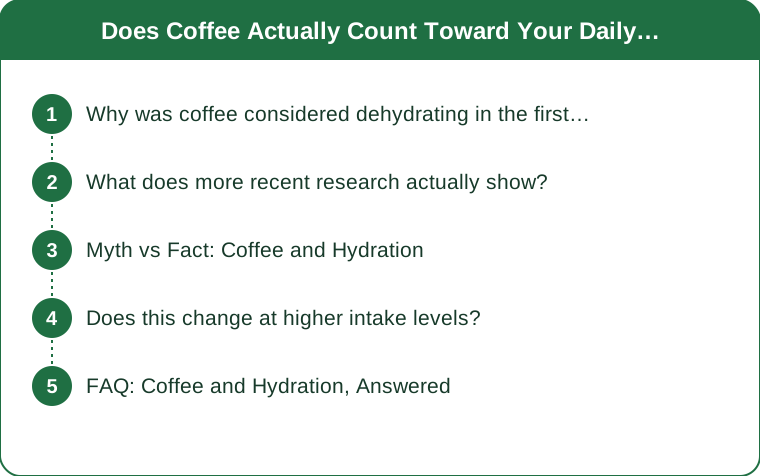
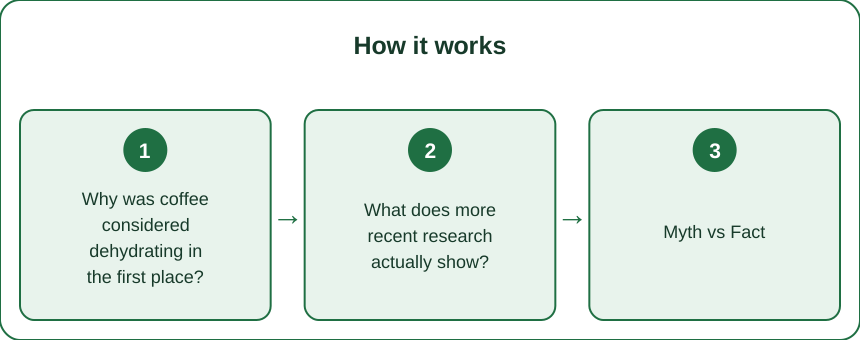
Why was coffee considered dehydrating in the first place?
Caffeine has a genuine, mild diuretic effect — it modestly increases urine output. Early research extrapolated from this that coffee must therefore be a net negative for hydration, without accounting for the substantial water content of the coffee itself, which is roughly 95% water by volume.
What does more recent research actually show?
Studies examining regular, moderate coffee drinkers (rather than people encountering caffeine for the first time) have found that the mild diuretic effect is largely offset by the water content of the beverage, and that regular users also develop some tolerance to caffeine’s diuretic effect over time — meaning moderate daily coffee drinkers see little to no net negative impact on hydration status.

Myth vs Fact: Coffee and Hydration
Myth: Every cup of coffee needs an extra glass of water to offset it. Fact: For moderate, regular coffee intake, this isn’t supported by current research — the coffee’s own water content largely covers this.
Myth: Caffeine’s diuretic effect is the same for everyone regardless of habitual intake. Fact: Regular coffee drinkers develop some tolerance to the diuretic effect, meaning occasional drinkers may notice more of an effect than daily drinkers.
Does this change at higher intake levels?
Yes — at higher intake (5+ cups, or unusually large amounts of caffeine), the diuretic effect becomes more pronounced and can start to have a more noticeable net effect on hydration, which is part of why moderate intake, rather than unlimited amounts, is the relevant qualifier in current research.
FAQ: Coffee and Hydration, Answered
Should coffee still count toward a daily water intake goal?
For moderate intake, most current research supports counting it as contributing fluid, rather than requiring extra water to compensate.
Does the same apply to tea, given it also contains caffeine?
Yes — tea’s caffeine content is generally lower than coffee’s, and the same water-content logic applies, often even more favorably.
Is there a hydration difference between hot and iced coffee?
Not meaningfully — the water content and caffeine level are the more relevant factors, not the temperature of the drink.
TL;DR:
- Coffee’s water content largely offsets caffeine’s mild diuretic effect for moderate drinkers
- The old “coffee dehydrates you” advice is outdated for typical, regular intake
- Regular coffee drinkers develop some tolerance to the diuretic effect over time
- Higher intake (5+ cups) is where the net effect becomes more relevant to consider
A morning coffee isn’t working against daily hydration goals for most people — it’s quietly contributing to them.
Keep Reading
This article is for general informational purposes only and is not medical advice. Always consult a qualified health professional for guidance specific to you.