How Altitude Quietly Changes Your Hydration Needs
Quick Answer: Above roughly 5,000 feet you lose noticeably more fluid through breathing, because the air is dry and you breathe faster and deeper. Altitude also increases urine output in the first days and blunts thirst — so you’re losing more while feeling less inclined to drink. Plan on adding roughly 1-1.5 liters per day above 8,000 feet, and include sodium rather than relying on plain water alone.
You drank the same as you always do. By the second afternoon of a mountain trip you’ve got a dull headache, your legs feel heavy, and you’re blaming the elevation.
It probably is the elevation — just not the part you were thinking of.
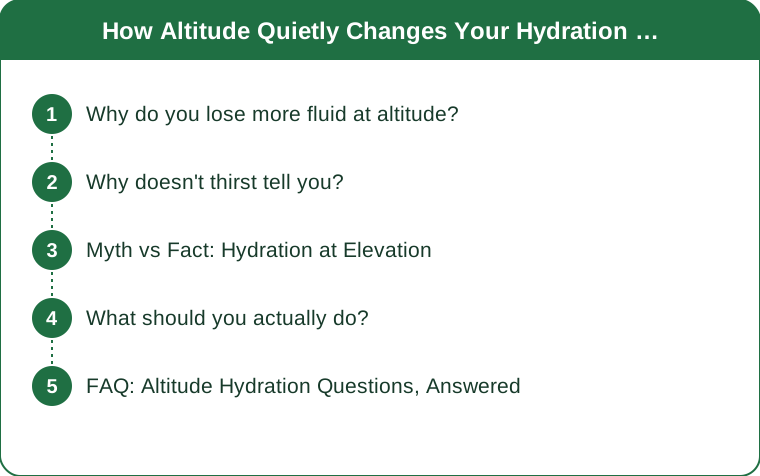
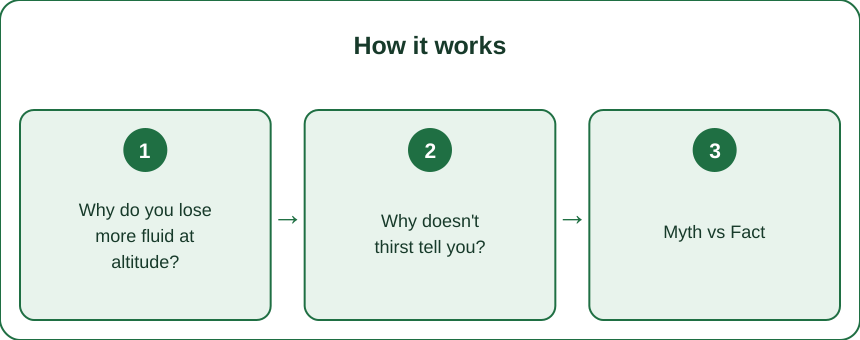
Why do you lose more fluid at altitude?
Three mechanisms, and only one of them is the one people expect.
Respiratory water loss increases substantially. This is the biggest and least visible. Air at altitude is both thinner and considerably drier, and you’re breathing faster and deeper to compensate for lower oxygen availability. Every breath out carries water vapor with it — and you’re taking more of them, each from drier air that pulls more moisture. You can lose a meaningful volume this way per day at elevation without ever noticing.
Altitude diuresis. In the first days at elevation, most people produce more urine as the body adjusts fluid and bicarbonate balance. This is a normal part of acclimatization and it isn’t a problem in itself — but it means a real fluid deficit accumulates unless you’re drinking more.
Sweat you never see. Dry mountain air evaporates sweat almost immediately, so you never feel wet. This is exactly the illusion that gets people in cool, dry conditions: skin stays dry, so it doesn’t feel like you’re losing anything, and intake drops accordingly.
Add them together and the total daily fluid loss at 8,000-10,000 feet can be considerably higher than at sea level, with almost none of the usual sensory cues.
Why doesn’t thirst tell you?
Because thirst is a mediocre signal in general, and altitude makes it worse.
Thirst tends to lag actual fluid deficit — you typically feel thirsty after you’re already down, not at the moment the deficit starts. At altitude, several things push it further off:
- Appetite and thirst are both blunted at elevation for many people, especially in the first few days
- Cool air suppresses drinking behavior. People drink far less in cold conditions than in warm ones at the same fluid loss — the temperature cue overrides the need
- The loss is happening through your breath, which produces no sensation at all, unlike sweating
The practical result is a consistent pattern: people arrive at altitude, feel less thirsty than usual, drink less than usual, and lose more than usual. That combination is why day two and three are typically the worst.
It also muddies the picture with altitude sickness, since mild dehydration and mild altitude sickness share symptoms — headache, fatigue, poor sleep, low appetite. They’re separate things and dehydration does not cause altitude sickness, but being dehydrated makes you feel considerably worse either way.
Myth vs Fact: Hydration at Elevation
Myth: Drinking a lot of water prevents altitude sickness. Fact: It doesn’t. Altitude sickness is caused by ascending faster than your body adjusts to lower oxygen, and no amount of water changes that. Staying hydrated makes you feel better and keeps dehydration from being mistaken for altitude sickness — that’s the real benefit. Gradual ascent is the actual prevention.
Myth: You can just drink to thirst like anywhere else. Fact: Thirst is blunted at altitude and the loss is largely respiratory, which produces no cue at all. This is one of the few situations where scheduled drinking genuinely beats drinking to thirst.
Myth: More water is always better. Fact: Overdrinking plain water while losing sodium is its own problem, and it produces a headache that looks identical to the one you’re trying to fix. Fluid needs sodium alongside it.
Myth: It only matters on serious mountains. Fact: The effect starts becoming noticeable around 5,000 feet — which includes Denver, Santa Fe, Salt Lake City, and a great many ski towns and trailheads. Plenty of people meet this on a work trip, not an expedition.
Myth: You’ll adapt in a day or two and it stops mattering. Fact: The diuresis settles within a few days, but the increased respiratory loss continues as long as you’re at elevation, because the air stays dry and you keep breathing more.
What should you actually do?
Practical and specific, since the general advice to drink more is exactly what fails here.
Add roughly 1-1.5 liters per day above 8,000 feet, and about half that in the 5,000-8,000 range. This is on top of whatever you normally drink, and on top of any exercise needs.
Drink on a schedule for the first three days. Don’t wait for thirst. A glass with every meal plus one mid-morning and one mid-afternoon puts most people close. This matters most in the first 72 hours, when diuresis and blunted thirst overlap.
Include sodium. With respiratory loss you lose relatively more water than sodium, but you’re also drinking more, and plain water alone dilutes what you have. Salt your food normally, or use an electrolyte drink once a day. This is the piece most people skip, and it’s often what separates the headache resolving from it persisting.
Use morning urine color, but know its limits. Pale straw is a reasonable target. It’s less reliable in the first day or two at altitude because of the diuresis, and vitamins will throw it off entirely.
Adjust for alcohol seriously. Alcohol at altitude is the classic mistake — it adds a diuretic effect on top of one already in progress, and it interferes with sleep, which is already disrupted at elevation. If you’re going to drink, add an extra glass of water for each one and expect the following day to be worse than it would be at home.
This is general information, not medical advice. A headache that worsens, nausea and vomiting, confusion, or breathlessness at rest are signs of altitude sickness, not dehydration — descend and seek medical attention.
FAQ: Altitude Hydration Questions, Answered
How long before my body adjusts?
The increased urine output typically settles within about three days. The respiratory water loss doesn’t go away — it continues as long as you’re in dry, thin air, so the higher intake needs to continue too.
Does this apply on a plane as well?
Yes, and by the same mechanism. Cabin air is pressurized to roughly 6,000-8,000 feet and is extremely dry, so you lose fluid through breathing throughout the flight. This is a good part of why you arrive feeling terrible — and why flying to a mountain destination stacks two fluid deficits back to back.
Can I just drink sports drinks the whole time?
You can, though most are high in sugar for this purpose. A better approach is plain water for most of your intake with one electrolyte drink daily, or simply salting your food normally and eating regular meals.
TL;DR:
- Altitude increases fluid loss mainly through breathing — faster, deeper breaths in very dry air, with no sensation at all.
- The first days add altitude diuresis on top, while thirst is simultaneously blunted.
- Add roughly 1-1.5L per day above 8,000 feet, and drink on a schedule for the first 72 hours.
- Include sodium; plain water alone can leave you with the same headache you’re trying to fix.
- Hydration does not prevent altitude sickness — gradual ascent does.
If your next trip is to anywhere above 5,000 feet, start the scheduled drinking on the travel day itself. The flight already put you partway into the deficit before you arrived.
Keep Reading
This article is for general informational purposes only and is not medical advice. Always consult a qualified health professional for guidance specific to you.