Eating Your Water: The Summer Foods That Hydrate While You Chew
Quick Answer: Roughly 20–30% of your daily fluid intake comes from food, not drinks. Cucumber is 96% water, lettuce and celery about 95%, watermelon and strawberries 91–92% — and unlike plain water, they arrive with potassium and magnesium attached. Two generous servings of high-water produce is worth something like two extra glasses, which is why heavy-produce days genuinely reduce how much you need to drink.
Hydration advice has a fixation problem. It’s all bottles, ounces, apps that buzz at you, and color charts you’d rather not think about.
Meanwhile there’s a whole department of the grocery store that is, functionally, a beverage aisle with fiber in it — and nobody counts any of it.
Summer produce is the most efficient hydration system available, and it has the significant advantage of also being lunch.

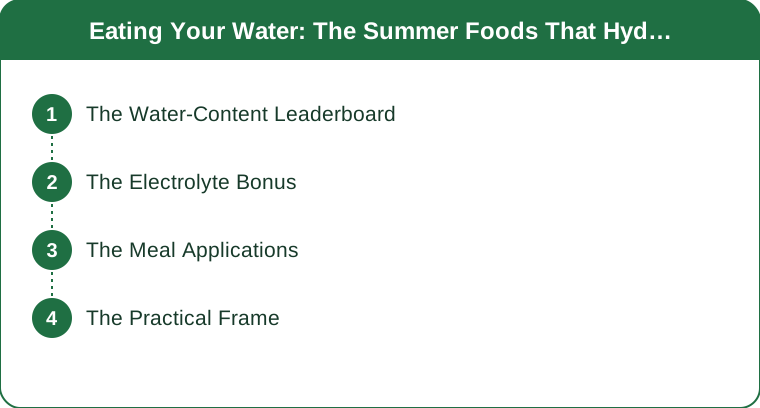
Which Foods Have the Highest Water Content?
The leaderboard, and it reads like the late-August farmers market by design:
- Cucumber — 96%. Effectively a crunchy beverage. One medium cucumber is about 8 oz of water.
- Lettuce and celery — 95%. Iceberg gets mocked for having “no nutrition,” which is unfair given that hydration is a nutrition function.
- Zucchini and tomatoes — 92–94%. Both cook down into things that are still mostly water.
- Watermelon and strawberries — 91–92%. A two-cup serving of watermelon is roughly 14 oz of fluid.
- Cantaloupe and peaches — 88–90%. Slightly denser, still doing serious work.
The pattern is not an accident. The season provides exactly what the season demands, which is one of the few pieces of folk food wisdom that survives contact with a nutrition label.
For scale: a large salad with cucumber and tomato plus two cups of watermelon adds up to something in the neighborhood of 20 oz of fluid — around two and a half glasses — arriving on a plate you were going to eat anyway.
Do Hydrating Foods Work Better Than Water?
Not better. Differently, and in a way that matters more the more you sweat.
Plain water is pure fluid. Produce hydrates with minerals attached — watermelon and cantaloupe bring potassium, leafy greens bring magnesium, and most vegetables carry a small amount of sodium along with them. Those are the electrolytes that determine whether the fluid you take in actually stays where it’s useful instead of passing straight through.
That’s the practical case for the fruit plate after a hot walk: it’s doing a meaningful part of the sports-drink job at whole-food prices, without the 30 grams of sugar and the color that doesn’t occur in nature.
The fiber matters too, in a quieter way. Water bound up in the structure of a food is absorbed more slowly than water drunk from a glass, which means a longer, steadier availability rather than a spike and a bathroom trip.
None of this makes produce a replacement for drinking. It’s the other 20–30%, and it’s the part almost nobody is counting.

How Do You Actually Eat More Water in Summer?
Five applications that require no discipline whatsoever, because they’re all things that taste good.
Cold cucumber-melon salad. Cucumber, cantaloupe or watermelon, mint, a squeeze of lime, a pinch of salt. Takes four minutes, keeps three days, and the salt is doing electrolyte work rather than just seasoning.
Gazpacho. Soup as a beverage, formally. Tomatoes, cucumber, pepper, garlic, olive oil, blended. A bowl is roughly 10–12 oz of fluid plus the potassium from the tomatoes.
Watermelon, feta, and mint. The combination that converts skeptics. The salt in the feta is the reason it works — it’s the same principle as salting melon, and it makes the fruit taste more like itself.
Smoothies as breakfast hydration. Frozen fruit plus yogurt or milk lands somewhere around 12–16 oz of fluid before you’ve thought about a water bottle.
The crudité and hummus tier. Cucumber spears, celery, cherry tomatoes, snap peas. Snacking that hydrates is the lowest-effort version of this whole idea.
Myth vs Fact: Food and Hydration
Myth: Only water counts toward hydration. Fact: Every fluid-containing food and drink counts, including coffee and tea. The idea that caffeinated drinks dehydrate you nets out false at normal intakes — the fluid in the cup outweighs the mild diuretic effect.
Myth: You need eight glasses of water a day regardless of what you eat. Fact: The eight-glasses figure never had strong evidence behind it, and official intake recommendations explicitly include water from food. On a heavy-produce day your drinking target genuinely eases.
Myth: Fruit is too sugary to be a good hydration source. Fact: Two cups of watermelon has about 18g of sugar alongside 14 oz of water, fiber, potassium, and vitamin C. Comparing it to a soda is comparing two different things that happen to share one ingredient.
Myth: If you’re thirsty, you’re already dehydrated. Fact: Thirst is a normal, functional early signal, not a failure state. It’s a reasonable guide for most healthy adults — it becomes less reliable in older adults and during heavy exertion, which is when a schedule helps.
Mini FAQ
Can you get all your hydration from food?
Not practically. Food supplies roughly 20–30% of fluid intake for most people, and pushing that much higher would require eating an unrealistic volume of produce. Treat it as a supplement to drinking, not a replacement — the useful version of this idea is “the watermelon counts,” not “the bottle doesn’t.”
What are the best hydrating foods for hot weather?
Cucumber, watermelon, cantaloupe, celery, lettuce, tomatoes, strawberries, and zucchini — all above 90% water and all in season right now. Add a pinch of salt to anything you’re eating specifically for post-sweat rehydration; the sodium is what helps you retain the fluid.
Do hydrating foods help with dehydration symptoms?
For mild everyday dehydration — the afternoon headache, the flat feeling — food and fluid together help, and the mineral content is a genuine advantage over plain water. Actual dehydration with dizziness, confusion, very dark urine, or a racing heart is a medical situation, not a watermelon situation. Get help for that.
TL;DR:
- Food supplies 20–30% of your daily fluid, and summer produce is the densest source.
- Cucumber 96%, lettuce and celery 95%, watermelon and strawberries 91–92%.
- Produce hydrates with potassium and magnesium attached, which plain water doesn’t.
- A cucumber-tomato salad plus two cups of watermelon is roughly 20 oz of fluid.
- It supplements the bottle rather than replacing it — but on heavy-produce days the drinking target genuinely eases.
Cucumbers as beverages, watermelon as electrolyte delivery, gazpacho as a loophole. The bottle keeps its job — the fork just joined the hydration department, and its benefits package includes dessert.
Keep Reading
This article is for general informational purposes only and is not medical advice. Always consult a qualified health professional for guidance specific to you.