Why You Drink Less Water Working From Home Than in an Office
Quick Answer: Office hydration is driven by structural cues - walking past a water cooler, coffee rounds, meetings that end and start, the walk to a shared kitchen. Working from home removes all of them, and thirst alone is a weak and delayed signal. Most people who drink less at home have not become less thirsty; they have lost the prompts that made drinking automatic. Rebuild the cues rather than relying on remembering.
You have a tap in the next room and a kettle five steps away, and yet at 4pm your glass is where it was at 11am. Somehow the office - with its terrible water cooler across the building - kept you better hydrated.

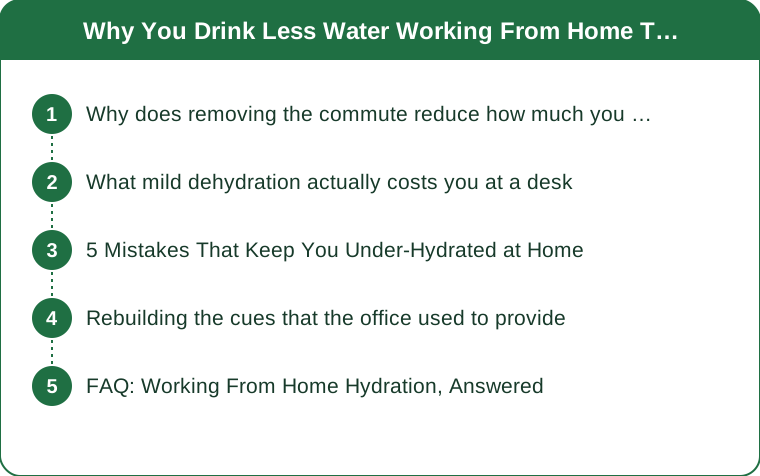
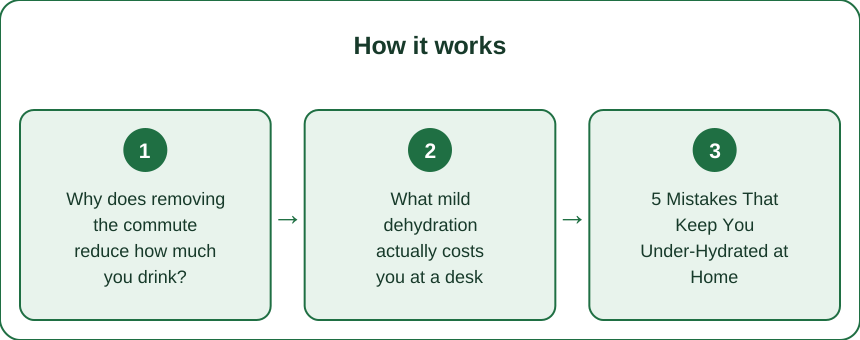
Why does removing the commute reduce how much you drink?
Because the drinking was never intentional in the first place.
Office hydration is mostly incidental. You get up for a meeting and pass the kitchen. Someone offers a coffee round. You refill on the way back from another floor. None of these are decisions to hydrate; they are movements that happen to include drinking.
Working from home removes movement almost entirely. With no commute, no room changes between meetings, and no shared kitchen, you can go four hours without standing up. Fewer transitions means fewer opportunities for the incidental drinking that made up the bulk of your intake.
Thirst is a weak and delayed signal. By the time you feel thirsty, you are already meaningfully down on fluid, and mild dehydration produces fatigue and reduced concentration well before it produces obvious thirst. Relying on thirst alone reliably under-delivers.
Social cues are the ones people miss most. Coffee rounds, lunch with colleagues, and someone else standing up to get water all prompt drinking. Alone at a desk, nothing prompts anything.
Deep focus suppresses interoceptive signals. When absorbed in work, the internal signals that would normally prompt a break - thirst, hunger, needing to stand - get filtered out. Home working often means longer uninterrupted focus blocks, which sounds productive and quietly costs you.
And ironically, proximity works against you. Knowing the tap is right there means the decision can always be deferred, whereas an inconvenient office cooler required planning - and planning meant filling a large bottle.
What mild dehydration actually costs you at a desk
The effects are more relevant to knowledge work than most people realise.
Concentration and short-term memory degrade with mild dehydration, at fluid losses small enough that you would not necessarily notice thirst. For work that consists almost entirely of concentration and short-term memory, that is not a trivial effect.
Fatigue is the most common symptom and the most misattributed. The 3pm slump gets blamed on lunch, on the caffeine wearing off, or on poor sleep. Dehydration is a frequent contributor and the easiest of those to test - drink a large glass and see whether the next 30 minutes improve.
Headaches are strongly associated with dehydration, and a headache that develops through an afternoon at a desk is worth treating with water before painkillers.
Mood is affected too. Studies of mild dehydration report increased perception of task difficulty and reduced mood, both of which look like a bad day at work rather than a fluid problem.
The distinction worth drawing: none of this means drinking more water fixes tiredness generally. If you are well hydrated and still exhausted, water is not the answer and the search should go elsewhere - sleep, iron status, thyroid, or simply workload.
This is general information, not medical advice. Persistent fatigue, frequent headaches, or unusual thirst warrants a conversation with a healthcare professional rather than more water.

5 Mistakes That Keep You Under-Hydrated at Home
1. Using a small glass. A 250ml glass requires six or seven trips to reach a reasonable intake, and each trip is a decision you might not make. A large bottle on the desk requires two decisions a day. The vessel does most of the work.
2. Waiting for thirst. Thirst lags behind fluid loss and is easily suppressed during focused work. If your entire strategy is noticing thirst, you will consistently under-drink.
3. Counting on coffee alone. Coffee does contribute to fluid intake - the diuretic effect of moderate caffeine is modest and does not produce net fluid loss. But replacing a varied intake with four coffees means far less total volume, plus a caffeine load that affects sleep.
4. Keeping the bottle in the kitchen. Out of sight means out of mind, and it converts drinking into a task requiring a trip. On the desk, in view, is the single most effective intervention available.
5. Trying to catch up in the evening. Realising at 7pm that you have drunk almost nothing and consuming a litre before bed produces interrupted sleep rather than better hydration. Spread it across the day, and taper in the last couple of hours before bed.
And the bonus that surprises people: heating and air conditioning both dry indoor air considerably, increasing insensible fluid loss through breathing and skin. A home office with the air conditioning running in late summer is a more dehydrating environment than it feels.
Rebuilding the cues that the office used to provide
The goal is to make drinking automatic again rather than remembered.
Anchor drinking to something that already happens. A glass at the start of every meeting, with every coffee, and every time you stand up. Attaching a new behaviour to an existing routine is far more durable than a standalone intention.
Put a large bottle on the desk, in your line of sight. Visual presence is a genuine prompt, and a large volume reduces the number of decisions required.
Use meetings as the timer. Most home workers have a naturally segmented day. A glass at the top of each call turns your calendar into a hydration schedule you did not have to design.
Reinstate movement deliberately. The lost water intake is a symptom of lost movement, and the movement is worth restoring for its own sake. A walk to fill a bottle every couple of hours is a break, a stretch, and a drink at once.
Vary what you drink. Herbal tea, sparkling water, and squash all count. People who insist on plain water only tend to drink less overall, and total fluid is what matters.
Front-load the morning. A large glass on waking and another with breakfast establishes a good baseline before the working day has a chance to absorb your attention.
And measure once, not forever. Track intake for two or three days to see where you actually are. Most people are either fine and worrying unnecessarily, or dramatically low and unaware. Either finding is more useful than continuing to guess.
FAQ: Working From Home Hydration, Answered
Why do I drink less water at home than at the office?
Because most office drinking is incidental - prompted by movement between rooms, coffee rounds, and colleagues. At home those cues disappear, and thirst alone is a weak and delayed signal that does not replace them.
Does coffee count toward hydration?
Yes. The diuretic effect of moderate caffeine intake is modest and does not produce net fluid loss, so coffee contributes to daily fluid. The practical issue is that replacing everything with coffee reduces total volume and adds a caffeine load.
How much water do I actually need?
It varies with body size, activity, and environment, so a single number is unhelpful. Pale straw coloured urine is a reasonable practical indicator, with the caveat that supplements and some foods change urine colour independently of hydration.
Can dehydration really cause an afternoon slump?
It can contribute. Mild dehydration is associated with fatigue, reduced concentration, and increased perceived task difficulty. It is worth testing with a large glass of water before assuming the cause is lunch or caffeine timing.
Should I drink a lot in the evening to catch up?
No - it produces interrupted sleep rather than better hydration. Spread intake across the day, front-load the morning, and taper in the last couple of hours before bed.
TL;DR:
- Office hydration is incidental, driven by movement and social cues that home working removes entirely.
- Thirst lags behind fluid loss and gets suppressed during deep focus, so it is a poor sole strategy.
- A large bottle in your line of sight replaces six decisions with two.
- Anchor drinking to meetings, coffees, and standing up - existing routines beat new intentions.
- Front-load the morning, count tea and squash, and stop trying to catch up at 9pm.
You did not become less thirsty when you stopped commuting. You stopped walking past the kitchen eleven times a day.
Keep Reading
This article is for general informational purposes only and is not medical advice. Always consult a qualified health professional for guidance specific to you.